
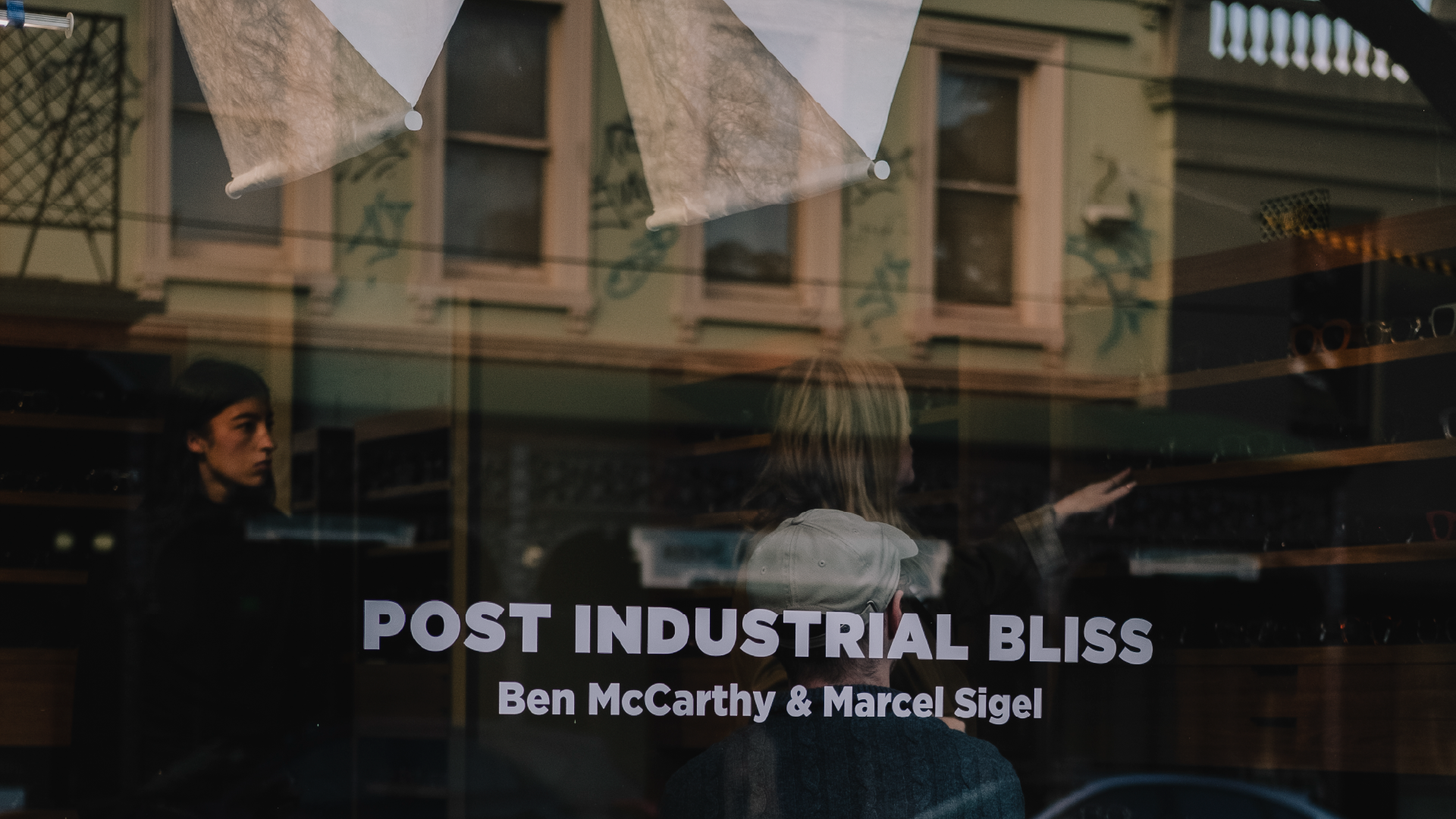
With the conclusion of Melbourne Design Week last week, we've taken the time to reflect on another outstanding exhibition and the opportunity to showcase the event with the Fitzroy and wider design community for the sixth year in a row.
Melbourne Design Week is a cornerstone of the city's cultural calendar, captivating audiences with its diverse exhibitions and innovative design concepts. This year we proudly hosted the third chapter of Post Industrial Bliss, an ongoing collaborative exhibition by designers Ben McCarthy and Marcel Sigel that explores new ideas in furniture and lighting through bold forms, craft processes and industrial detail. Since its debut at Seekers in 2024, the series is now an anticipated show within the festival – a conversation between two makers who share a design language without necessarily speaking in unison.
Set in the windows of Seekers, the installation presented all-new works conceived specifically for Melbourne Design Week 2026 – objects that sit somewhere between the functional and the sculptural, visible from the street yet inviting a closer look from within. Aluminium appears across the exhibition in various states – processed and finished in different ways – contributing to a palette of silver, white and royal blue that emerged accidentally across Ben and Marcel's independently developed works, before finding quiet harmony within the Seekers showroom.
See the photo gallery below of all the beautiful works we had on display.
--
In conversation with Ben McCarthy
Ben McCarthy Studio operates across overlapping fields – industrial design, making and art – with a practice grounded in the belief that objects should carry the mark of how they were made.
For Melbourne Design Week 2026, Ben presented two new works: the Spoon Light and the Strip Lantern. The pieces are rooted in a simple starting point: to present objects based on iconic typologies, such as a table light and pendant light, but in a pared back way to let the materials shine. A geometric sensibility runs through both objects, with pure forms and an honest distillation of shape. Scale was also considered carefully. The large, lightweight Strip Lantern fills the window and provides a soft glow in the showroom after dark, while the small Spoon Light greets you at the entrance after you move inside the Seekers space.
What made Seekers feel right for this work?
There seems to be a really nice harmony with our work within this space – it's a really nice match for us both. A brilliant big window on our favourite street to showcase the work, with an open-minded and design-focused community walking by.
What do you hope someone walking past on Gertrude Street takes away from it?
We wanted to have larger things to fill the room, and smaller things to discover up close. Hopefully the exhibition brought a few extra people who appreciate design to the Seekers showroom, and as an added bonus, they enjoyed meeting the Seekers team.
Tell us about a key decision moment during your design process for this collection.
The decision of whether to leave the interior of the Spoon Light raw or hand polish it! Polishing the aluminium material by hand took a long time, but I was really happy with the light reflecting on the smooth surface.

Spoon Light
A sand cast aluminium table light, designed to cradle a standard bulb and fitting in a way that celebrates material and process. The exterior is left rough, preserving the texture of the sand casting. The interior is hand polished via a painstaking process to capture light and reflection from within.

Strip Lantern
Conceived to be as large as possible while collapsing as small as possible. The geometric shade is made from Tyvek, a non-woven paper-like fabric, suspended from a strip light. A weighted tube at the base acts as a counterweight, opening the volume of the shade and filling it with light. The lanterns hang from the ceiling on adjustable nylon straps; in this installation, one suspended from the other. From different angles the form shifts entirely, offering intriguing silhouettes that feel like a different object depending on where you stand. When it is time to pack down, the counterweight slides free and the whole piece rolls into a postal tube.
--
In conversation with Marcel Sigel
Marcel Sigel Studio is founded on the notion that design should be impassioned, provoking the emotions, feelings and behaviour of those who come into contact with it. Working across product, furniture, lighting and space, the Melbourne-based studio brings a rigorous design sensibility to every object – one that balances visual restraint with quiet personality.
For Melbourne Design Week 2026, Marcel presented two new works: the Squared Chair and the Column Tables. The pieces share an uncompromising geometric sensibility and a commitment to materiality as the starting point. His celebration of design revolves around process and materials – pitting the tangible connection forged through handmade elements against the precision of machinery and the scalability of industrial production.
What's the moment in the making process you enjoy most?
When the first prototype comes together – when you can walk around the piece, touch it, and feel its presence within a space.
What made Seekers feel right for this work?
When we first walked down Gertrude Street with the idea of presenting the exhibition within a retail space, Seekers immediately stood out. Its clean, uncompromising aesthetic, refined material palette and thoughtful detailing felt closely aligned with our own approach to design. The small, gallery-like space at the front of the store seemed like a natural fit – intimate yet highly considered.
What ultimately made the collaboration feel so right?
The Seekers team shared a similar appreciation for design, materiality and beauty, making the entire experience feel genuinely aligned from the outset.

Squared Chair
An exploration of simplicity and restraint. Exaggerated proportions and uncompromising geometry produce a blunt, almost primitive form, with materiality at its core. Made from pultruded fibreglass – a material typically found in factories and industrial environments, rarely associated with furniture – each component is internally bolted, keeping the structure visually clean and resolved. Within its highly industrial character lies an unexpected beauty: a textured surface that subtly bleeds through the saturated colours intrinsic to the material, revealing the manufacturing process and embedding a sense of honesty and narrative within the object itself. "I wanted a dramatic contrast in positive and negative form – balancing visual weight with openness and void."

Column Tables
Conceived as a series of small graphic sculptures, the Column Tables push conventional functionality to the edge of reason. Flat, uncompromising table surfaces give way to highly visual forms imbued with character and personality. The legs pierce through the top plane, disappearing through shadow and falling directly to the ground.
A final moment of appreciation for the artwork details:


--
PHOTO CREDIT: Melbourne Design Week, Post Industrial Bliss Series, 2026. Image by Thomas O’Brien.

